Posts

Showing posts with the label opinion

The Thing About Healthcare...

Adam Davidson of The New Yorker had a good opinion piece about why healthcare is so important and unlike anything else and I thought I would highlight some of his points here. I struggle with healthcare spending and government policy because, on the one hand, healthcare is spiraling out of control and growing way beyond inflation or economic growth (not just in USA but in Canada and most of the developed world actually); but on the other hand, it is so important that as Davidson alludes to below, it should really be thought of more as an investment in the long-run future of the country rather than an expenditure per se. Titled " What the G.O.P. Doesn't Get about Who Pays for Healthcare " (Mar 23 2017) and directly addressing the Republican Party in USA, Adam Davidson writes (as usual, bolds are by me): In economics, when a person has some money, they can do one of two things: invest it or use it to buy something they want to consume. Most of the time, they consume. T...

Opinion: You Can't Build a Society with Flat Taxes

Libertarians, classic conservatives and many on the right* love flat taxes and always seem to be in favour of flat taxes but I have never seen it ever last. I thought I would comment on it after reading that Estonia has started to abandon its flat tax . Apparently the first country to introduce flat tax in Europe, Estonia is starting to back off the flat tax. In my opinion, you just can't build a society with flat taxes. If anything, history seems to indicate that as societies advance, their taxes become more progressive. The flat tax helped a lot of ex-Communist states after they gained independence when no one was paying taxes and the system was completely dysfunctional, but it is hard to build a society with such a system. Wealth grows exponentially and hence accrues to the top few disproportionately--most investors probably know that 80% of the American stock market is owned by around 10% of the population--and it's hard to do anything at the societal level if most of...

Sunday Spectacle CC

Image
2016 US Elections America just held its 58th presidential election, which also coincides with the House and partial Senate and some State Governor elections. Although many were surprised by the results, it wasn't a huge surprise to me. Going into the election, polls consistently showed Hilary Clinton with a slim 3%-4% lead over Donald Trump. Clinton had a bigger 10%+ lead but it fell precipitously after the surprise big-news-turned-into-no-news FBI "bombshell" a week before the election (this clearly deflated a lot of Democrats and independents that were going to vote for Hilary). The fact that Hilary Clinton was already viewed negatively by many neutrals (for the corruption and Libya war and so on) didn't help matters. Results seem to suggest that Hilary's loss was due to supporters not turning up, rather than Trump attracting more. In the end, Clinton ends up with a majority of the votes by a slim margin (mostly due to high votes in populous states like Cal...

Opinion: Do the Flaws With Private Equity Need Fixing?

Image
(Image by boston.com. Downloaded from jamieflinchbaugh.com ) In his latest for The New Yorker , James Surowiecki points out two major flaws with private equity as it currently operates. In particular, he raises the carried interest controversy and the notion that private equity uses debt to extract profits, while, at times, running the company into the ground. Should the government scrutinize how private equity is allowed to operate in America?

Warren Buffett's Evolution and his Three Investment Styles

Image
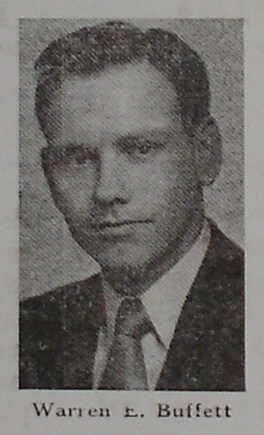
A Young Warren Buffett In a comment to one of my posts , Mark Carter, who incidentally appears to have a  good blog worth checking out , asked: "Buffett Prime is 1970's to early 1990's" Could you elaborate? I have vaguely indicated how I view Warren Buffett in the past, but I thought I would detail my view of his investing behaviour. This is more of an opinion piece and many others would disagree with me (if you do, I'm curious to hear your thoughts). I don't follow Warren Buffett as closely as many value investors so I may get some facts wrong. My view is that Warren Buffett went through three different phases, with each consisting of different investment techniques. The overall investment theory remained the same—what people call value investing—but his execution, tactics, and strategy differs across the three phases. Some people may break up his career into additional periods but my feeling is that the three I will describe essentially capt...

Opinion: Thoughts on Bill Miller's Exit

Although I don't post much these days, I do follow business/investment news and Bill Miller, CIO at Legg Mason Capital Management, will retire from managing the main value fund. Legg Mason grew from a no-name Boston shop to one of the largest mutual funds, largely due to Bill Miller. He had a strong streak back in the 90's but ended up performing poorly, with near-catastrophic bets on financials, over the last 5 years. A lot of people don't like Bill Miller—some "value investors" don't consider Miller as a true value investor—but I was, and still am, a fan of him. In addition to Marc Faber, Warren Buffett, Charlie Munger, and David Dreman (at least his book), Bill Miller was one of the key investors who influenced me during my "formative" early years. I suspect what influenced me in the last 5 or so years—good as well as bad habits and knowledge—will probably, permanently, shape my future. Although I was a fan of Miller, I don't think he is ...

Opinion: USA shouldn't create a repatriation tax holiday

The Obama administration has been looking into waiving the rapatriation tax on foreign income. The thinking is that this would lead to investment within the country and lead to job creation. For those not familiar, many US corporations are sitting on huge cash balances but a lot of that money is overseas (earned from their foreign operations). If they bring that back into the country, they would pay a repatriation tax. Many executives of multinational firms have been pushing the US government to waive the taxes. Most readers, that own shares in these firms, would benefit from such a tax holiday. I am not American so take it for what it's worth but I believe the US government shouldn't waive the tax.

Opinion: Should auditors provide interpretation in the accounting statements?

The way the accounting profession is going, it may very well end up like the legal profession. What I mean is that, once upon a time—say a hundread years ago—lawyers were respected individuals; Abraham Lincoln was one and many were held in high regard. Right now, the public has a very negative perception of lawyers. Some even claim they are not helping society very much. If you are a lawyer, you still earn above-average (relative to the whole economy) compensation but the respect you get is nothing like it used to be. My feeling is that the accounting profession may head in that direction. There have been quite a number of crises of late—the recent accounting by financial firms and the fraud at companies like Enron and Worldcom a decade ago come to mind—which the auditors didn't catch. The auditors are well-paid professionals that earn above-average compensation but if they are incapable of flagging serious accounting problems then why are shareholders paying them so much? Writ...

Some articles you may find interesting - December 4th of 2010

Here are some articles I found interesting. I have a bunch related to politics and this may anger some of you so if you don't want to hear it, skip over the WikiLeaks stuff near the bottom. As usual, not in any particular order... Some Canadians snapping up US residential real estate (MoneyVille): Real estate bulls such as John Paulson have said that it's a great time to buy American real estate but I am not so sure. Although not as risky as buying near a peak, I can see someone not making any money for years. Having said that, the funds mentioned in this article are buying prime Florida real estate—I assume they are prime?—so they should be ok in the long run. After all, they don't build those sandy white beaches in America. A bubble in private Internet companies? (Dealbook): The privately rumoured valuations of Internet companies like Twitter, Groupon, Zygna, and others, often reach billions of dollars. Some of these companies are revolutionary and likely will dominat...

Warren Buffett receives presidential medal of freedom... plus thoughts on several other issues

Image
I think he is deserving of it—some won't agree—but it looks like Warren Buffett will receive the Presidential Medal of Freedom . Although awards of any sort are always controversial, given questionable recipients in the past, this is an important one. This is the highest civilian honour in the United States of America (the highest civilian award in Canada is the Order of Canada , although some seem to suggest it is the Order of Merit). You can't get anything higher unless you are in the military. Warren Buffett will be receiving the medal along with several other prominent individuals such as Yo-Yo Ma (artist), Bill Russell (basketball player), George H. W. Bush (former president), Angela Merkel (German chancellor), and a few others. Although some may disagree with awarding it to Warren Bufffett, I think it is an appropriate choice. If America represents capitalism, it is only fitting the greatest capitalist of modern times, Warren Buffett, receive the highest civilian hono...

Opinion: A parallel to the Great Depression & Other thoughts on Unemployment

Image
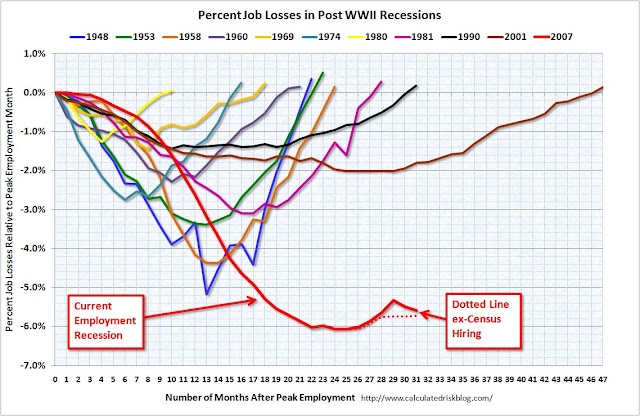
One of the shocking things I encountered when reading up on the Great Depression was how wages actually went up. Yet, huge swaths of the population were unemployed and suffering. One of the things, perhaps the key one, that was driving that scenario was the fact that productivity gains were accruing to those who had jobs while those without jobs barely could find a decent job. Maybe I'm an egalitarian at heart—my egalitarian side and my capitalist side often fight deep inside me—but there's almost something cruel about that. I hate to say it but a similar thing appears to have unfolding right now in America. The New York Times reports on the similarity to the Great Depression : In the deep economic slump of the mid-1970s, the average hourly pay of rank-and-file workers — who make up four-fifths of the work force — fell 6 percent, adjusted for inflation. In the early 1980s, the average wage fell 3 percent. Even in the mild 1990-91 recession, it fell almost 2 percent. But si...

Opinion: Tesla Motors IPO could by the symbol of the upcoming electric car revolution

Image
Tesla Motors (TSLA), the niche electric car maker, had its IPO today. It raised $202 million. Tesla hasn't a made a profit since it was founded in 2003, and is expected to post losses until 2012. The market was very receptive to the stock and it was one of the few that was up today (it was up 41% today.) If electric cars take off, this could be a very symbolic event that will be looked upon in the future. It'll be kind of like the Yahoo! IPO in the 90's, which ushered in the Internet era. The strong interest in Tesla shares indicates that investors are willing to finance this emerging industry. On the other hand, electric cars could turn out to be a big bust. There is a lot of hype around them and it remains to be seen if they will revolutionize personal transportation.

Opinion: Time to start curbing the growth of derivatives

When the capital development of a country is the byproduct of the operations of a casino, the job is likely to be ill done. — John Maynard Keynes How dangerous are financial derivatives to societies? I don't have an answer so this is more of a post to make you think and maybe respond. I have never really worried about the damage derivatives pose to society. My feeling is that the damage won't be that bad because derivatives are a zero-sum game. I still think that's true but, given how financial institutions making huge mistakes end up running up to the taxpayer, I am slowly shifting my position towards a negative view. I have a bad feeling that developed societies—only they have sophisticated derivatives markets—may be edging closer to irreparable harm.

Opinion: EU and its hedge fund side show

The financial crisis clearly illustrates how greater regulation is required, but I have no idea why the EU is going after the shadow banking system (hedge funds, private equity, etc.) Yves Smith at Naked Capitalism seems to be in favour of such a move but as far as I'm concerned, it's a complete waste of time and detracts from the real reform that is required. Some policymakers in the EU appear to believe that these players were the cause of the financial crisis and/or made it worse. Recent stories have even suggested the belief by some that countries like Greece wouldn't be in a crisis if hedge funds didn't bet against their bonds. If one sat back and thought about it, they would quickly realize that none of that is true.

Opinion: In defense of Lehman Brothers

I don't like witch hunts—especially when one can't tell who the witch is, or even if they exist. Even worse is when you kill a human while witches are all around you. Such is the case with Lehman Brothers. Some may find this article a bit surprising and out of character for me. I'll state my position up front and say that I don't think the executives of Lehman Brothers have committed crimes anywhere near the degree that the mainstream media and the masses believe. It looks like very few share my view, other than Charlie Gasparino of all people  (yikes, when Charlie and I are on similar pages, the world is probably coming to an end ;) ) Some of the blogs I read appear to believe they have found the witches who nearly caused the financial system in America to collapse, but I believe they are grossly mistaken. The clueless masses are calling for the execution of someone—anyone!—and whoever is associated with Lehman Brothers seems like an easy target. Although I am c...

Opinion: One of Warren Buffett's management call mistakes - Jeff Immelt of GE

In fairness, we’ve seen plenty of successes as well, some truly outstanding. There are many giant-company managers whom I greatly admire...Jeff Immelt of G.E [and a few others]....come quickly to mind. — Warren Buffett 2006 Shareholder Letter Warren Buffett is one of the best investors at judging management—he has to be, given how he is a concentrated investor. But he does make mistakes and Jeff Immelt of GE is one of his mistakes. However, Jeff Immelt is an unusual example of a mistake for several reasons. Buffett, as well as many others, would probably disagree with me (that's why I consider this post strictly an opinion piece.)

Opinion: GE's problems appear to be a bit worse than I thought

When it came to the financial crisis, one of the most shocking things for me was when industrial giant, GE, ran into liquidity problems. It is not wholly surprising that companies like Lehman Brothers, Bear Stearns, Citigroup, Fannie Mae, and others, faced serious problems given their business involved mortgages. But I was truly surprised when it looked like GE, which I had perceived as very strong (I think it was even rated AAA—but don't remember), looked like it was toast. GE's profitability had been strong for the last 20 or 25 years (with some moderately-sized issues along the way) and it is one of the few firms that consistently matched market expectations. I didn't know a huge chunk of its profits in the last decade was from their financial operations but even then, most of its assets were pretty solid. When the commercial paper market locked up, only then did I learn that GE relied heavily on short-term debt. In any case, my impression was that GE's problems ...

Opinion: Really tough for media companies to work under the Chinese regime

Almost everyone has heard of the controversy over Google's threats to pull out of China. Some always wondered what type of company Google was, and this situation should finally prove that Google is basically a media company. I think the currently unfolding situation goes to show how difficult it is for media companies to work within a totalitarian regime. Other industries can sort of get away with questionable practices but media companies will always be, either under the watch of the state, or culpable in human rights violations of the state. Anyone who knows about politics knows that brainwashing the population is one of the most powerful tools available to governments. In fact, when a crisis unfolds, the first task of many tyrants is to take over the media or to initiate propaganda. I once recall Noam Chomsky pointing out that propaganda was widely used until citizens started resisting it. There was even a book called Propaganda or something like it (don't remember the e...

Opinion: The US govt should re-appoint Ben Bernanke

Resistance is mounting for the re-appointment of Ben Bernanke to the Federal Reserve chairperson position. Those in favour of re-appointment heavily outweigh the dissenters but I sense a shift in the mood. MarketWatch reports that a senator is attempting to block the re-appointment: Sen. Bernie Sanders placed a hold Wednesday on the nomination of Ben Bernanke for a second four-year term as chairman of the Federal Reserve, saying it's time for a change in economic policies. Sanders' hold could delay the vote on Bernanke's confirmation, but likely won't derail it. The hold means the Democratic leadership would need at least 60 senators to agree to bring the nomination to a vote, instead of the 50 needed without the hold. As I have said many times before, Ben Bernanke is not perfect but he is the right person for the job right now. If USA is indeed undergoing a deflationary bust as I suspect, Bernanke is one of the most qualified people out there. This doesn't mean tha...

Opinion: Good investors not necessarily good at personal finance

Many probably assume that good investors are very good at personal finance. After all, if you know something about financial or economic analysis, you would be good at managing your finances too, right? I don't think so. My view shouldn't be that surprising. It's kind of like how a good mechanical engineer may have skills to design a car but that doesn't necessarily mean that they have the skills to be a mechanic. You'll notice what I am saying when you look at blogs. I feel that there is almost two seprate ecosystems: one dealing with investing, and another dealing with personal finance. I rarely see much of an overlap in the participants. The investment-oriented bloggers almost always seem to deal with finance, economics, and capital markets. In contrast, the personal finance bloggers all seem to be passive investors and I see very little work dealing with stockpicking, financial statement analysis, macroeconomic theories, and so forth. Anyway, the best example of...