Posts

Showing posts with the label investment evaluation

A Look at Tripadvisor (TRIP) and its Two Problems
Image
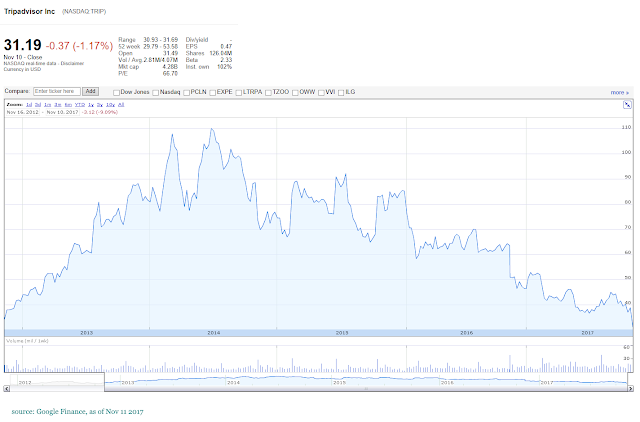
It's hard to find anything that seems cheap in the current bull market but as in any market, some stocks do sell off for various reasons. One of the ones that attracts me is Tripadvisor (TRIP*). As the chart below illustrates, the stock is trading near a 5-year low and is down about 70% from its 2014 peak (share count hasn't changed much and no major return of capital to shareholders). (* You can also own TripAdvisor indirectly through John Malone's holding company, Liberty TripAdvisor, with ticker symbols LTRPA/LTRPB. You should evaluate this option as well. Sometimes holding companies, especially if it is well run like most Malone companies have historically been, are better; sometimes they are not (there may be additional overhead/fees for the holding company, may have worse shareholder rights (doesn't favour minority shareholders) and market generally places a holding company discount on such shares and they may be illiquid)) I remember looking briefly at Tr...

First Look: Chipotle Mexican Grill (CMG)

Image
This isn't my type of company. It isn't in my circle of competence...but I've been researching and studying the industry. It doesn't have the valuation I like... but that depends on what one thinks is normal earnings. What it is, is a contrarian, broken, growth stock with very good backward-looking numbers and uncertain future. Overview Chipotle Mexican Grill (CMG) is a restaurant chain that apparently pioneered and popularized "fast casual" dining--basically a cross between fast-food (e.g. McDonald's, KFC) and casual (eg. TGI Friday's, Chili's, Boston Pizza). The food is Mexican, prepared similar to fast-food restaurants and priced in between fast-food and casual (a burger at a fast-food place might be $4 whereas a burrito at Chipotle will be something like $6). I don't know much about restaurants and am not really into food--sometimes I wonder if I should even be looking at this company--but from reading numerous articles, it se...

Online Social Networks and the Ascent of Facebook

Image
(source: Facebook ) As bizarre as this sounds, one of the most valuable innovations in technology over the last several decades is Facebook's "Like" button. That's what has propelled the company to a galaxy-orbit valuation for its forthcoming initial public offering, filed Wednesday. This is not only because the word "like" is, like, the identifying word of an entire generation. It's because computing has evolved beyond just taking directions from humans—and instead is cozying up to us and sniffing out our emotions and intent. — Andy Kessler, Wall Street Journal Three decades ago, if someone had told you that a company that didn't make any physical products, had existed for less than a decade, and had less than 3,000 employees would be worth $100 billion, would you have believed it? But here we are, three decades later, and stock market participants appear ready to award a $100 billion valuation to Facebook (FB). Are they crazy? Is ...

Evaluation of Netflix's Financials

Image
Netflix Headquarters (Image source: Getty Images, via Huffington Post ) I took a look at some of the qualitative aspects Netflix (NFLX) in prior posts ( here and here ) and it's time we look at the financials. I think any success or failure with Netflix's stock will still come down to its business model and competitive dynamics but, nevertheless, the financials provide a valuation guide for an entry point. The stock has run up so much this month that its valuation isn't attractive right now. Most of the shareholders of Netflix—or at least those represent a big chunk of the volume—appear to be growth investors or momentum traders, so you will see more volatility in this stock than a typical company. As I have mentioned before, Netflix is going through a major transformation, from a DVD-by-mail business to an online streaming business, so its financials prior to 2010 aren't reflective of its future. Furthermore, the company has grown so rapidly within an year t...

A Look at Netflix's History and Its Business Transformation

Image
It's hard to imagine how I haven't purchased a stock in over two years — certainly not a good way to succeed in investing :( One of my New Year's resolutions is to focus more on investing and work much harder. In any case, I have been researching Netflix (NFLX) lately and it keeps getting more interesting by the minute. I remember an anonymous reader said in my prior post he/she thought Netflix was worth around $50 to $60 per share and he/she would buy it around $40. Well, the stock did decline to $62, before skyrocketing recently. There was also a roughly 10% dilutive capital raise in the last few months so the stock price is close to the range of the anonymous poster. It's still a high risk stock—it can easily go bankrupt within 10 years—but some of its qualities seem attractive. I took a preliminary look at its business model and competitive environment in  this post about two months ago, and thought I would write up its background and the transformation it is...

Preliminary look at Netflix (NFLX)

Image
Netflix (NFLX) has been in the news lately, and given its steep fall in its stock price, I thought I would take a look at it. This is an early look, focused on its business model. For those not familiar, Netflix is a US-based distributor of television and film content. It became the dominant DVD-by-mail rental service in the US, and has been transitioning into the online streaming business. Netflix used to be a "growth story" over the last few years, and favoured by growth and momentum investors. It rose more than 900% within just the last 3 years but has had a spectacular fall this year: As a contrarian, I became interested given its steep fall. The stock is off given poor results and some strategic mistakes by management.

Torstar Valuation (Part II)

There are many ways to value a business but one way is to lump all the techniques into two methods. One focuses on earnings, while the other concentrates on asset values. Typically each method suits a particular type of business, although you can apply both when looking at a business. Martin Whitman would consider the first method (earnings-oriented) when looking at "earnings common stocks"; while the asset value method is more useful for "wealth creation common stocks." The earnings method is what is most common on the Street. It basically involves trying to determine the value of a going concern based on future earnings. The wealth creation method is more rare, but Martin Whitman's Third Avenue Value Fund generally specializes in these. This method involves unlocking value through corporate restructurings, share buybacks, spin-offs, asset sales, and so on. Looking at earnings will not capture the possibility of wealth creation potential for these firms. Chec...

Preliminary Look At Torstar (TS.B) [Part I]

Image
I'm really intrigued by the idea of investing in a "newspaper" company. I hope this isn't my next great shooting-for-the-stars idea that's going to end up in flames. I have been reading up on the industry, as well as comparing some companies, and they look interesting. First thing to keep in mind, though, is that they are risky (especially if you don't know what you are doing like me.) You will certainly be going against the Street consensus which is that newspapers are in a long-term secular decline. It's not easy to argue against that, if you focus on the printed news side of things. Based on my read of history, newspapers have faced some industry-altering events in the past. The last big crisis faced by the newspaper industry was probably the rise of television news. The thinking back then was that television news was going to seriously damage printed news and possibly make it obsolete. It hurt the industry but not to the degree some anticipated. Howeve...

Ambac Margin of Safety Analysis

This post will capture the final piece of analysis I'll do before purchasing Ambac (still depends on how events unfold over the next few weeks). I initially evaluated Ambac a few months ago so read that to get details on Ambac's historical profitability and what it is capable of. The initial analysis, which occurred after the 1st sell-off in the stock but before the massive 2nd sell-off, didn't really go into valuation or risk. It quickly became obvious that valuation isn't the problem with Ambac (it's undervalued by almost any measure); instead, the real issue is risk. Margin of Safety Before I say anything, I should note that Ambac has a chance of going to zero ! As Mark Sellers (don't know who he is but just saw the interview at The Motley Fool), says in this interview , a company like MBIA can go bankrupt so he doesn't invest in it. So if you can't afford a total loss, none of the bond insurers are for you. If you want a beaten down financial that w...

Investment Evaluation: Ambac (ABK)

Image
Ambac (ABK) Investment Evaluation Initially Written: October 27, 2007 Last Updated: - Oct 27, 2007 I’m just a newbie investor with a contrarian tilt so feel free to e-mail or post comments to correct any mistakes or to improve things. Do not blindly base any decisions on anything I say; I don’t know what the hell I’m doing ;) . Also, since I write over a period of time, some facts and numbers may change from when I first looked them up (this is definitely the case with any market-price info e.g. P/E ratio). Summary Ambac (ABK) is the second largest debt insurance company, after MBIA Inc (MBI). Its business is to insure interest and principal payments on various debt for governments, infrastructure projects, mortgages, and so forth. Generally it doesn't insure the value of the debt, and only insures the payments. This is important because, given the credit problems in the mortgage and the ABS market, ABK will be spared the losses on the value of the debt. Due to credit issues and va...

Evaluation of Takefuji

Image
I evaluated a Japanese high-risk consumer lending company called Takefuji and am planning to take a position in it. I tried posting the report online but it's too big and formatting isn't the greatest but here it is (if anyone wants the PDF doc e-mail me): Takefuji (JP: 8564; TAKAF.PK) Investment Evaluation Written: June 27, 2007 Last Updated: July 17, 2007 Sivaram Velauthapillai (sivaram.velauthapillai[AT]gmail.com) I’m just a newbie investor with a contrarian tilt so feel free to e-mail or post comments to correct any mistakes or to improve things. Do not blindly base any decisions on anything I say; I don’t know what the hell I’m doing ;) . Also, since I write over a period of time, some facts and numbers may change from when I first looked them up (this is definitely the case with any market-price info e.g. P/E ratio). Summary Takefuji is a Japanese financial company that provides lending to high-risk consumers. It provides high interest unsecured loans to consumers who obv...