Posts

Showing posts with the label technology

Articles for the Week Ending February 4, 2017

Certainly an interesting start to the year, with an unusual US presidency, FedRes tightening underway, US$ strengthening, and Chinese capital outflows still continuing (or at least seems that way). Some governments appear to be becoming nationalist and protectionist and we may be seeing the end of the global trade boom. I need to think about this more but it sort of resembles the change from 1910s/1920s to 1930s. Things aren't exactly the same but that period was also characterized by a trade boom--countries were different and Asia/Latin America didn't play much of a role--followed by extreme retrenching from global trade. I also have a feeling that labour (workers) may do better over the next decade while capital (investors) don't do as well (relatively speaking). Basically the opposite of the last decade (if you are interested in this thinking, read the Jeremy Grantham GMO letter). Note that everything I say is from a developed country (USA/Canada/Europe/etc) point of v...

Articles for the week ending December 16, 2016

Some stuff I found interesting... in no particular order... (Recommended) " Napoleon Is Dead! Wait. That's a Stock-Market Scam." (Barry Ritholtz, Bloomberg, Dec 16 2016): Everyone has heard of fake news, which are more easily spread on the Internet, potentially having a political and social impact, but, believe it or not, it extends into the investing realm as well. Probably doesn't impact long-term investors that much but still something to watch out for. In fact, how many of you have heard of the fake-news-driven Great Stock Exchange Fraud of 1814? "China Halts Trading in Key Bond Futures as Panicky Investors Sell Securities" (Yifan Xie and John Lyons, The Wall Street Journal, Dec 15 2016): Not a major story in itself but something to watch and see if it is a trend... There have been several stories in various media of emerging market bonds selling off (due to rising US$ and rising US interest rates). Some macro investors speculate that emerging mark...

Articles of Interest for the week ending Nov 26 2016

Here are some articles I read recently that you may find interesting. This time around, very few are investing-related... " Google, Facebook, and Microsoft Are Remaking Themselves Around AI " (Cade Metz for Wired): Overview of how these tech companies are leading the research into AI. " Inside Fitbit’s Quest to Make Fitness Trackers Invisible " (David Pierce for Wired): I was thinking about wearables as a potential investment. In particular, Fitbit (FIT) has sold off since the IPO--it's kind of confusing since it seems like there was a big share dilution along the way--but is this a fad or is it the future? Fitbit certainly has the leadership position and strong brand (so far) and its balance sheet and income statement looks ok too. I probably won't invest since history is too short and it's hard to predict the future but I'm studying it a bit. " Can America’s Companies Survive America’s Most Aggressive Investors? " (Alana Semuels for T...

How do App Developers Make Money? Seems Completely Unsustainable

Something that has always puzzled me is how software app developers on mobile platforms (phones, tablets) make money. Some mass market products, such as games, make money off large volume and/or advertising but how about all the others? Writing for Stratechery , Ben Thompson illustrates the difficulty faced by app developers, particularly those developing productivity software (bolds by me): Paper is a transformative, device-defining app, and has been awarded accordingly by both Apple and the design industry . According to App Annie , as of June 21, Paper ranked 7th in the Productivity category according to downloads (119th overall after a recent jump), and 4th in revenue (108th overall). By every visible measure, FiftyThree, the makers of Paper, are the definition of an app store success story... But underneath the surface, things aren't so rosy: The problem for Paper is the same for all productivity apps in the App Store: there is no way to monetize your existing...

Jim Chanos' Bearish Views on Some Value Traps

Image
I ran across the following presentation by Jim Chanos and thought you will find it insightful. Even if you aren't into short-selling—I am not—it is useful to see what sort of investments you may want to avoid. Value investors tend to ignore macro views but those who are more influenced by macro may want to pay attention to bearish views of any investments they are considering. Back in May, Chanos gave this brief interview to Bloomberg briefly mentioning the topics covered in the presentation. The presentation covers Chanos' bearish thoughts on what he feels are some characteristics of value traps. He goes on to list several investments that he views as value traps. Here are two summary slides from the presentation. I share most of Jim Chanos' views and think investors should be careful with the areas he identified. For instance, I do think traditional PC manufacturers could lose big—he is bearish on HP—as tablets and mobile computing replaces PCs. Even compan...

Sunday Spectacle CLXXX

Image
A few days late but oh well... Great graphic by Asymco on the evolution of the computer industry... Evolution of the Computer Industry (source: " The evolution of the computing value chain ," by Horace Deidu, Asymco. June 19 2012)

Sunday Spectacle CLXXV

Image
Technology Adoption in America It's not easy to measure how quickly technology is adopted. One can come up with numerous methods, and the result can differ depending on how you count the starting point. Sometimes it is also hard to distinguish between devices. For instance, one of the sources below seems to count 'tablets' as something starting with the iPad, when a stricter view may place the starting point back in the late 90's or early 2000's (there were some tablets running Microsoft OS back then). Similarly, some people separate 'smartphones' from mobile 'feature phones' whereas others do not. In any case, the following graphs provide some insight into adoption rates. As to be expected, technologies that required building out huge physical infrastructure (like the electricity grid or the telephone network) took a very long time. Based on the results quoted by The Atlantic , it looks like the 'boom box' had the fastest adoption a...

Peter Thiel on What Makes A Great Technology Company & Other Thoughts

Image
(Image source: Vator News ) Some of you may have heard of Peter Thiel; most probably have not. Peter Thiel is a successful Silicon Valley entrepreneur and venture capitalist, who is famous for being a founder of PayPal and being the first outside investor in Facebook. He is somewhat controversial in that he is a libertarian and is influenced by Austrian Economics and has some extreme views (I actually share a lot of the libertarian views but I'm more of a liberal-libertarian and think that pure-libertarians sometimes forget that humans have a heart). If you find him interesting, you may want read this excellent New Yorker profile by George Packer from November of last year . I don't use this word on too many people but he is a brilliant man who seems quite innovative in his thinking. Blake Masters has been writing up the notes from a Computer Science course on entrepreneurship being taught by Peter Thiel. The notes were taken by him ( @bgmasters ) along with some notes...

Sunday Spectacle CLXIII

Image
The App Economy: iTunes App Store (as of May 2011; click on each image for larger picture) (source: Infographic by Stefanie Kraus for  148Apps , Chillingo and Chomp . Downloaded from " Apple Approves 500,000 Apps...and counting " at CoolInfoGraphics.com, Dated May 25, 2011.)

Online Social Networks and the Ascent of Facebook

Image
(source: Facebook ) As bizarre as this sounds, one of the most valuable innovations in technology over the last several decades is Facebook's "Like" button. That's what has propelled the company to a galaxy-orbit valuation for its forthcoming initial public offering, filed Wednesday. This is not only because the word "like" is, like, the identifying word of an entire generation. It's because computing has evolved beyond just taking directions from humans—and instead is cozying up to us and sniffing out our emotions and intent. — Andy Kessler, Wall Street Journal Three decades ago, if someone had told you that a company that didn't make any physical products, had existed for less than a decade, and had less than 3,000 employees would be worth $100 billion, would you have believed it? But here we are, three decades later, and stock market participants appear ready to award a $100 billion valuation to Facebook (FB). Are they crazy? Is ...

Sunday Spectacle CLXII

History of Radio (click on buttons at bottom left to activate larger infographic) Original source: " The History of Radio ," Sonos. Posted on February 6th, 2012. Embedded infographic from Visualizing.org

Evaluation of Netflix's Financials

Image
Netflix Headquarters (Image source: Getty Images, via Huffington Post ) I took a look at some of the qualitative aspects Netflix (NFLX) in prior posts ( here and here ) and it's time we look at the financials. I think any success or failure with Netflix's stock will still come down to its business model and competitive dynamics but, nevertheless, the financials provide a valuation guide for an entry point. The stock has run up so much this month that its valuation isn't attractive right now. Most of the shareholders of Netflix—or at least those represent a big chunk of the volume—appear to be growth investors or momentum traders, so you will see more volatility in this stock than a typical company. As I have mentioned before, Netflix is going through a major transformation, from a DVD-by-mail business to an online streaming business, so its financials prior to 2010 aren't reflective of its future. Furthermore, the company has grown so rapidly within an year t...

Sunday Spectacle CLVII

The Technology Ecosystem Demystified (source: " Startup Ecosystem: Predator vs. Prey " Downloaded from visualizing.org. Original source:  udemy blog )

How Much of a Threat are Technology Companies to Netflix? How About UltraViolet?

Image
You're using Internet Explorer 7, upgrade to a faster browser. Show me how I'm stuck using IE7, please don't show this again Remind me later One the claims by some Netflix bears is that technology companies like Microsoft and Apple will be a huge threat. Although things can change, technology companies are unlikely to compete successfully in fixed price video streaming services (they can, however, do fine in pay-for-download or pay-per-view digital content businesses). You get a feel for this with the following Reuters story via The Globe & Mail on Microsoft : Microsoft Corp has put its talks with media companies about an online subscription service for TV shows and movies on hold, according to people familiar with the discussions. The technology giant had been in intense talks with potential programming partners for over a year and was hoping to roll out the service in the next few months. But it pulled back after deciding that the licensing costs ...

Interview with Elon Musk

Image
Elon Musk is the co-founder of PayPal, SpaceX, Tesla, and SolarCity. He is through-and-through an entrepreneur with a technical mind and "scientific ambition" — by scientific ambition I mean those that dream of things that don't exist. People like Elon Musk are the ones that can have a big impact on society. Those interested in science, particularly clean energy and space, or entrepreneurship will like the following video. The video is Elon Musk's answers to questions posed by reddit.

The Year That Was, 2011

Image
How Was 2011? Here are some items from 2011... to keep you entertained in 2012. (anything marked with stars are worth checking out) Google Zeitgeist 2011 A Picture is Worth a Thousand Words   * The Year in Pictures - Part I   * The Big Picture - Boston.com   * The Year in Pictures - Part II   * The Big Picture - Boston.com   * The Year in Pictures - Part III   * The Big Picture - Boston.com Science in 2011: Triumphs, disasters and climaxes – in pictures The Guardian Must-see Science Videos of 2011 Cosmic Log on MSNBC.com   * Ten of the Top Science Videos of 2011   * Txchnologist   * The Most Important Graphs of 2011 * Derek Thompson for The Atlantic   * Top 10 Video Ads of 2011   * The Globe & Mail   * Slide Show: The Top Ten Art Sales of 2011   * Bloomberg Best Google Doodles of 2011 WebProNews.com Wallpaper* Graduate Direc...

Conversation Between Reed Hastings and Michael Eisner (Feb 2010)

Image
Here's a really good video from 2010 of a conversation at Churchill Club between Reed Hastings and Michael Eisner. Michael Eisner is the former CEO of Walt Disney and, although he is a bit past his peak and semi-retired, he is still worth listening for his experienced views.  Reed Hastings is the CEO of Netflix (NFLX) and although considered by some to be the worst CEO of the year (for some strategic blunders), I still think he is one of the top CEOs in Silicon Valley. I am always impressed with Hastings and I think he is sort of like a Bill Gates, in that he is a visionary who understands not just technology but the business environment. A lot of topics are covered in this discussion: technology, media, entrepreneurship, public education, corporate culture, you-name-it. I highly recommend it if you are interested in any of those topics . There are a lot of interesting issues discussed, including, compensation for executives, Netflix's unlimited-vacation policy, how the...

Netflix's Reed Hastings Being Interviewed by Charlie Rose (from 2005 and 2011)

I have been researching Netflix (NFLX) lately and checked out some Charlie Rose interviews with Reed Hastings, CEO of Netflix. One of the interviews is from December 27, 2005 and the other one is from earlier this year. Although his star has faded recently, Reed Hastings is one of the visionaries in Silicon Valley. Not only did he build up Netflix, a DVD rental and video streaming service, but he is also very knowledgeable about technology. If you are interested in technology, media, or education—he has some thoughts on education—check out the 2005 interview. I found the 2005 interview quite insightful and it is quite impressive to see him hit the targets his laid out back then. The recent video from May 4, 2011 is more narrow and is probably best for those who are interested in media, online streaming, and technology. Unfortunately, it seems that Charlie Rose doesn't allow recent content to be embedded so click on this link for the 2011 interview . As usual, Charlie Ros...

Sunday Spectacle CLII

Image
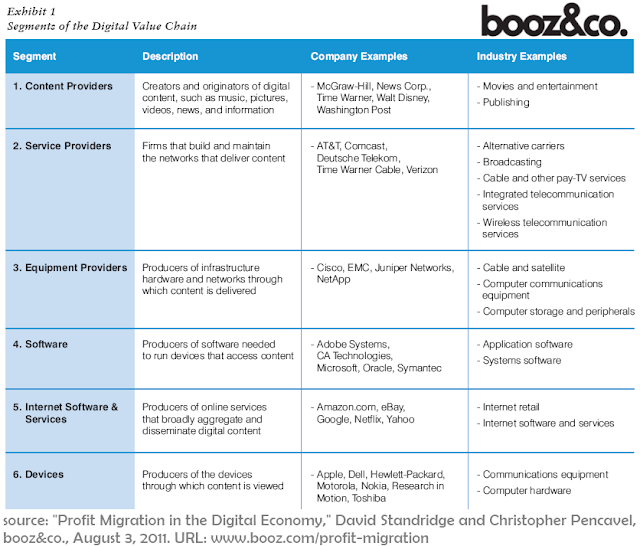
Digital Economy's Shifting Industry Profits (source:  “Profit Migration in the Digital Economy,” by David Standridge and Christopher Pencavel, Booz & Company white paper, August 2011, www.booz.com/profit-migration ) Sorry about the small fonts (I hate extracting from the booz&co reports since they aren't designed for online layouts). In any case, this is an important chart for those interested in the digital economy. Certainly any investor in the various industries that represent the 'digital economy' should pay attention to how the market is developing. Even if you don't invest in these companies, you may find the material interesting since the digital economy will play an integral role in society. The chart from a booz&co report (read the full report for more info) illustrates how the digital economy, which includes numerous different types of industries, ranging from content creators, to service providers to software and hardware...

Articles to start off the last month of 2011

The year is almost done... hope everyone has had a good year. Now that I'm Twittering , a lot of the articles will be duplicates for any Twitter follower. (Highly Recommended) John Paulson's arbitrage notes (Anh Hoang): John Paulson, before he became popular for short-selling mortgage bonds, was a successful risk arbitrageur. Special situations investing is something that amateur investors should look at. (Recommended) Charlie Rose interviews superinvestor Seth Klarman (CanadianValue for GuruFocus): Arguably the top value investor in the world right now, Seth Klarman rarely gives interviews so you should check this out. However, unfortunately, there isn't anything insightful about investing in the interview. One thing Klarman does point out is that he is still a Graham-type investor whereas Buffett has moved on to a, what I call, 'modern Buffett' investing style. The style that I aspire to is what I call 'Buffett Prime'. Roughly speaking, I would say...