Posts

Showing posts with the label yen carry-trade

David Einhorn bets big on a currency crisis

It's hard to tell how good David Einhorn is with his macro calls. I don't give him the same respect as many others, when it comes to his macro views. In any case, it looks like Einhorn is making some bold calls. MarketWatch reports that he is expecting a major currency crisis (interestingly not in USA): Greenlight Capital is betting on the possibility of a major currency collapse and a surge in interest rates, the hedge-fund firm's manager David Einhorn said Monday, citing ballooning government deficits in some of the world's most developed countries. ... On Monday, he said Greenlight has added new trades to this investment theme, buying long-dated options on much higher interest rates in Japan and other developed regions -- effectively giving the firm the chance to make big profits from a jump in rates. The options, bought from major banks, are tied to interest rates four to five years out, Einhorn noted. "Japan may already be past the point of no return," h...

Charts of Some Key Items

Image
Some important charts... US$ has been rallying like crazy. It actually erased the losses for this year and is actually posting positive YTD return. I interpret this as capital flight into safe currencies...the Yen has also done well lately. The commodity-influenced Canadian dollar has suffered lately... all charts courtesy stockcharts.com ... (note that there are quite a few different ways to show currencies and these charts are showing the currency index.) S&P 500... US$ chart... Yen chart... Canadian dollar chart... oil (west texas intermediate)... gold...

Has Everyone Forgotten About the Yen Carry-trade?

Image
The Yen carry-trade, which used to make the news a few years ago, seems to have been forgotten by many. The carry-trade is still alive and will be so until interest rates in Japan go up and/or investing within Japan becomes more attractive than overseas. Contrary to the popular view of hedge funds being the big players in the carry trade, my opinion is that the carry trade is due to local Japanese investors investing overseas. I have posted articles about this point in the past but to recap, Japanese investments are so unattractive that locals (mostly Japanese women supposedly) invest overseas. I ran across a post by Schreyer at GaveKal's forum examining the relationship between the Yen carry-trade and stocks. Schreyer provides the chart below showing MSCI World stock index versus Euro/Yen currency cross: Although this is a short-term covering only 2 or 3 years, it does provide a quick glance of the relationship between the Yen carry-trade and stock market investments. Both stocks...

Worth Increasing US$ and Yen Exposure

Image
Over the last year I have been wrong--big time--regarding the US$. I paid for my incorrect decision by losing around 10% of my portfolio last year due to the US$ decline against the Canadian dollar. However, I am maintaining my mildly bullish view of the US$. The US$ will likely fall while its economy weakenes and the Federal Reserve cuts rates, but I believe it has declined sufficiently against the Canadian dollar. My feeling is that the US$ will mostly fall against the strong Asian currencies and the Yen. I am also strongly bullish on the Japanese Yen. The Yen has increased quite a bit in the last few months but I believe it has further to go (but this can take years). I am planning to increase my exposure to the US$ and Yen. Ideally, I would like to hold 50% of my portfolio in Yen-denominated assets (such as Japanese stocks). The Japanese stock market has been selling off like crazy so I'm not sure if I should just convert some money to Yen and wait, or to plunge headfirst while...

Yen Carry-trade Continues to Unwind

Image
The Yen carry-trade is continuing to unwind as the US markets weaken. The Yen is up around 10% for the year against the US$ (the chart shown below is Yen against a basket). (source: stockcharts.com) Many investors, including me, have been expecting the Yen carry-trade to unwind for a while now. If the US markets correct much further, I actually think the US$ may stabilize or start to rally. It seems unlikely but there has often been big capital flight into US$-denominated assets during crises in the past. The strengthening Yen will present an interesting situation for Japan. For the last decade or more, Japan has relied heavily on exports. This is why the JCB was always tried to manipulate their currency downwards. If the Yen strengthens, Japanese exports will get hit and the economy can't depend on exports to the same degree as they have in the past. It remains to be seen how well Japan adjusts to the stronger Yen (assuming the Yen does strengthen permanently). Their government is...

Japan, the Yen, and Takefuji

Image
General Thoughts on Japan As I have remarked many times before, I am planning to focus my future investment research on Japan. Until I do more reading, I won't know for sure but right now it fits my profile and strategy. It is out of favour (can you believe it is actually negative for the year in US$ terms?), transparent (easy to get information for the large companies, and corporate governance is improving), relatively low valuations (on a P/E basis it is not cheap but if you think earnings are depressed then it isn't so bad; on price/book it is pretty attractive), etc. Not sure when I'll get to it but my goal is to read these two books in the near future: Japan on the Upswing , and Japanese Money Tree . Anyway, here are some articles I read on Japan recently (some of these articles are old and I only read them now)... Barron's had this run down of the attractiveness of Japan. I liked the article but my thesis for investing in Japan is to avoid the 'China play...

Random Thoughts

Image
Here are some random thoughts running through my head... Housing Stuff There is a lengthy 5-page article on Countrywide Financial (CFC) at New York Times. I glanced at it and it runs over the history of CFC and some of what happened in the lending industry recently. Pretty good article for anyone that is thinking of investing in CFC or learning about what the lenders were doing in the last couple of years. One of the big risks for anyone like me dumb enough ;) to consider investing in debt insurers is the chaos that may be unleashed if some mortgage insurers fail. I am still working through my examination of Ambac (ABK) and it seems that it should survive, but I am not so sure about the smaller companies that insure mortgages. News articles like this makes me think that there could be further sell-offs in the debt insurers if one or more of the mortgage insurers collapse. Although value investors generally don't try to time stuff, I'm not a value investor and I don't want...

Thoughts on Housing, Bullish Market Stance, and the Loonie

Image
Am I Ever Going to Stop Talking About Housing? I don't think I'm going to stop talking about housing until... oh... late 2008. On top of it impacting the economy, it also presents potential opportunities. Housing-related sectors are some of the most contrarian sectors out there. Paul Krugman of New York Times recently summarized some key housing charts in his blog entry. The charts easily illustrate the high-level view of what is unfolding. Check out the link to get a quick overview of the unprecedented boom in housing, and the inevitable unprecedented collapse that is unfolding. All the charts that were referenced by Paul Krugman are important but the one that contrarians may want to pay attention to is the one on defaults by mortgage origination year. The key insight, to me, is that securitizations before 1995 were fairly good--even for subprime. But anything after 1995 (or thereabouts) is highly questionable. I am thinking of investing in Ambac (ABK) (I reviewed it yesterd...

US Long Bonds Moving Along With the Yen

Image
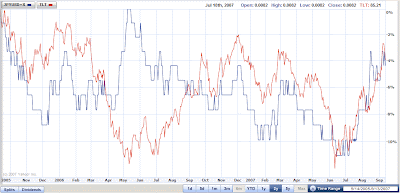
Although this isn't anything dramatic, I have noticed the high correlation between US long bonds and the Japanese Yen lately. The following chart of Yen and TLT, the 20 yr US Treasury bond ETF, illustrates this point perfectly. (source: finance.yahoo.com) For all of 2007, but especially in the last few months, the US long bonds have behaved similarly as the Yen. I am not sure if this is a coincidence that won't going to last, or if this is a pattern that may develop further, but I'll be keeping a close eye on it. This could simply be capital flight (both Yen and US Treasuries are safe havens in terms of valuations) so it may be a coincidence. Since I am long TLT, and think the Yen carry-trade may unwind soon, it may not make sense to sell TLT until the Yen finishes its move.

Random Thoughts for the Day: Friday Aug 17 2007

Well, I guess the wild week ends on a wild note with the Federal Reserve lowering the discount rate . Note that this a weaker tool in the Federal Reserve's arsenal, with a cut in the Federal Funds Rate being the last action that has the biggest impact on the economy and financial assets. Some analysts think the FedRes is not going to cut the Fed Funds Rate. I suspect they are trying to avoid that since that is inflationary. This move was a surprise to me but it wasn't that out of the norm. The markets recouped some of their losses from yesterday but it wasn't really a strong rally. Most of the markets opened higher and then declined slowly through the day. The key things I observed today are: The Yen carry-trade unwinding still seems to be ongoing. The Yen index weakened a bit today but it gave back hardly any of its gains from yesterday. But the US$ index declined today, and gold was up a little bit (not quite as much as I would have thought given the decline in the US$ an...

Random Thoughts for the Day: Thursday Aug 17 2007

Image
Well, today was a wild day in the markets. Many of the markets were down more than 2% during the day, with the higher-beta emerging market or commodity-sensitive ones down a lot more, but there was a massive rally near the end of the day and the losses were pared. S&P 500 even finished in the positive (just barely). Here is a chart of the S&P/TSX Composite which finished with a loss of -1.53% but was down around -4% during lunch. (source: The Globe & Mail ) Almost everything sold off and ended up with losses. If it weren't for the big rally near the end, some sectors like materials and energy would have been down quite a bit. The S&P/TSX is close to negative, if it isn't negative already (same goes for the Dow and S&P500). The most important thing to note is that there was a massive rally in the Yen: (source: StockCharts.com) This is an amazing appreciation for a currency in one day. Things like this just doesn't happen often so one should pay attentio...

Two Important Currency Charts

Image
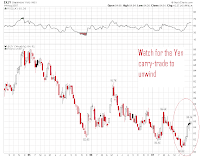
I consider the following two charts to be some of the most important charts to watch. They are the currency charts of the US$ index and the Yen index. If the stock market goes into a correction, I expect the Yen carry-trade to unwind. So that's something we should watch for. If the US$ rallies during a correction, it likely means capital flight to safety. Contrary to some people's opinion, the US$ is still the safest currency around. A sharp rally in the US$ will likely result in corrections in emerging markets as well. Not only will capital fly away from the unsafe emerging markets to the safe US$-denominated assets, but an impetus will also be provided by the fact that returns in foreign markets in US$-terms will not be so attractive. The decline in the US$ in the last few years has meant that American investors had an incentive to shift capital to foreign markets.

Japanese Retail Investors & the Yen Carry-Trade

I came across a two-week old article from TheStreet.com by Daniel Harrison talking about the Yen carry-trade. Apparently so-called "Japanese housewives" (BTW, this does not necessarily refer to stay-at-home women; It is a general term applied to retail investors it seems) are betting on foreign currencies and sectors like gold. They seem to be moving into the South African Rand, pushing it up and hurting export-oriented goldminers such as Harmony (HMY) and Gold Fields (GFI). Net income is down 50% in some of these companies because the Rand has appreciated much more than their their sales in US$. I have always known most of what was said in the article but I didn't realize how big the Yen carry-trade speculation was. It seems like the speculation on currencies has taken on some bubble-like proportions: In Japan, the carry trade is reminiscent of the dot-com bubble in 2000, he explains, in which foreign-exchange speculators include Japanese housewives, cab drivers and hai...