Posts

Showing posts with the label global

Louis-Vincent Gave on China (Dec 2023)

Image
I'm a big fan of Louis-Vincent Gave, and given that he is an expert on China, it is very finely to look at what is happening in China. This is a good interview from December 2023 by Manifold touching on many issues including China's future growth issues, possible future trajectory of its economy, US debt concerns, and some longer term investment ideas of you think US dollar will weaken due to inflation from potential monetization of US debt (LVG thinks Latin American debt, value stocks, commodities and maybe gold are with looking into.)
Sunday Spectacle CCXXIX

Image
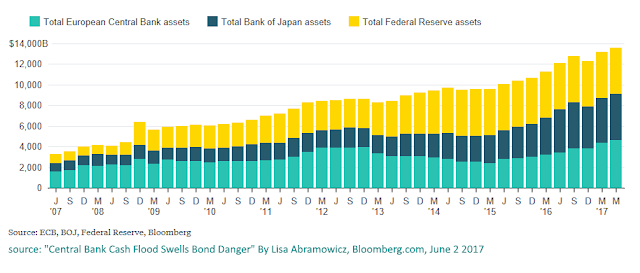
Central Bank Money Printing Central banks generally increase assets by printing money and buying them, so the charts below are indicative of their money printing. Historically, increase in central bank balance sheet (i.e. increase in money printing and supply of money) has led to inflation in goods and services (this is offset by deflation or wealth destruction and a bunch of other factors). Recently most of the money printing has been used to buy financial assets--for instance, the JCB is a big owner of Japanese stocks--so it is not clear to me if the situation will be similar to the inflationary busts we have seen in the past. Beyond inflation, too much central bank asset purchases also distorts the market and crowds out the private sector--not a good thing from a capitalist point of view (private sector makes better capital allocation decisions than the government). It's interesting how the main 3 developed country central banks have behaved over the last decade. ...

Sunday Spectacle CCXX

Image
Forbes 2000 Largest Companies in the World (2016) Top public companies in the world according to Forbes, which uses a combination of revenue, profits, assets, and market value. source: " The World's Largest Companies 2016 ," Forbes.com, May 25, 2016.

Sunday Spectacle CCXII

Image
Potential Impact of US Border Tax Bloomberg recently had an article quoting Deutsche Bank report on the impact of the proposed American border tax--there are several ones being floated around but this report seems to assume 20% tax, which is closer to the Republican House position--and there was a nice graphic of the impact on various countries. The biggest negative impact is forecast to be in Mexico, Vietnam, and Canada. All three will likely enter a recession immediately (assuming retaliatory taxes offsetting the GDP contraction aren't enacted). For some reason the data doesn't seem to include China, which will probably be the #2 loser from such a tax. (source: " Here's a Glimpse of the Global Trade Carnage From a U.S. Border Tax ," Jeff Black, Bloomberg, February 1, 2017) When we are closer to the imposition of the US border tax, which seems almost certain under the Trump administration, I'll write a more detailed post but here are...

Articles for the Week Ending February 4, 2017

Certainly an interesting start to the year, with an unusual US presidency, FedRes tightening underway, US$ strengthening, and Chinese capital outflows still continuing (or at least seems that way). Some governments appear to be becoming nationalist and protectionist and we may be seeing the end of the global trade boom. I need to think about this more but it sort of resembles the change from 1910s/1920s to 1930s. Things aren't exactly the same but that period was also characterized by a trade boom--countries were different and Asia/Latin America didn't play much of a role--followed by extreme retrenching from global trade. I also have a feeling that labour (workers) may do better over the next decade while capital (investors) don't do as well (relatively speaking). Basically the opposite of the last decade (if you are interested in this thinking, read the Jeremy Grantham GMO letter). Note that everything I say is from a developed country (USA/Canada/Europe/etc) point of v...

Sunday Spectacle CCXI

Image
Future of the World is Already Written... Demographics is one of these things that is hard to change and once set in motion, can last for a lifetime... (source: " Global Demographic Trends Shape Policy Environment ," Mark A. Wynne, Economic Letter, Dallas Federal Reserve, July 2016, Vol 11, No 7; main page link )

Newbie Thought: When Should You Look Overseas?

Image
If you were strictly investing in your local country's stock market, would you be missing out on anything? Ever wonder whether one should look at foreign markets? Well, assuming that your country's local stock market valuation isn't extremely high--if the whole market is high and expected to remain high, one has reason to look overseas (or to different asset classes)--and ignoring macro factors--you have reason to invest overseas if you have an opinion on future currency exchange rates, political risk, global economic secular themes, etc--there is really one big reason one should consider foreign markets. The single biggest reason (except for macro and overvaluation reasons) to consider foreign markets has to do with the composition of your local market . For most countries, certain industries or sectors may constitute a big chunk of the market. If your circle of competence is not in those dominant sectors, you may have limited choices and have a hard time. For...

Opinion: Potential Consequences of Trump Presidency

Image
Given the unpredictable nature of Donald Trump and the lack of a well-articulated platform and ideology that he adheres to, it has become a cottage industry to predict how the US government over the next several years--at least until mid-term elections in 2 years--will behave. I don't like Donald Trump, his policies or the people he surrounds himself with--Steve Bannon, the ex-Goldman Sachs banker/ex-film producer and almost-far-right proponent, and Bill Walton, the former Allied Capital CEO who some of you may recall being profiled by David Einhorn over a decade ago with some employees eventually being convicted of fraud come to mind (it's almost farcical that Trump would put Walton in a role to influence the policies of the SEC and SBA when those two agencies contributed to the conviction of wrongdoing by Walton's firms)--but as I have mentioned in the past, unlike most other countries, the US President has far less power than many imagine. Having said that, since...

Sunday Spectacle CLXXXII

Image
How Educated is the World? Education vs Age in the Modern World Competitiveness of countries, and their standard of living, has historically been driven by education. This relationship may not be as strong in the future—my view is that higher education isn't as big of a distinguishing factor as it was in the past—but very-low education still prevents certain countries from competing on the world market. The chart below from McKinsey Global Institute shows education vs age for key countries. It is obvious that the higher-educated countries are older. It's not clear to me if this is due to lower-educated populations having lower lifespans and/or having more kids. Those scoring low on the education scale are, as expected, poorer as well. (click for larger image) (source: " The world at work: Jobs, pay, and skills for 3.5 billion people ," McKinsey Global Institute. June 2012)

Baltic Dry Index Approaches Multi-decade Low

Image
One of the biggest bubbles over the last decade was the shipping bubble. Driven by the trade boom with China and other emerging markets, large investments were made in ships. Companies mortgaged their future and purchased a large number of ships, with the assumption of good times continuing forever. Long-time readers may recall when I wondered about the industry (from a contrarian point of view) back in 2009 in this post and this one . Time flies but even then, it seems like the shipping industry is still working through its overcapacity problem. It's interesting to note that they are still having problems—this, without China entering any slump, yet. Marketwatch reports, The warning signs being flashed by the collapsing Baltic Dry Index (BDI), a leading global economic indicator, may reflect the folly of misguided expectations during the prior global economic boom, according to Hong Kong-based shipping analysts. New super-sized ships ordered up during the era of cheap cre...

Sunday Spectacle CLVIII

Image
Will China Ever be As Rich as USA? China's total GDP will surpass USA within a few decades simply due to its larger population. But will each of its citizens be as rich as USA soon? There is nothing to say China—or some other country—won't ever surpass the wealth of USA on a per capita basis, but it's not as likely as many assume. The Federal Reserve Bank of Dallas examined this question in their June 2011 Economic Letter  (bolds by me): So, is it likely that Chinese living standards will ever match those in the U.S.? To get a handle on this question, it is useful to look at other countries’ experiences over a long period. Many nations underwent development miracles in the latter half of the 20th century. Reviewing data on the evolution of global living standards over the period reveals two interesting facts. First, there are several countries where per capita GDP exceeds that of the U.S., often by significant amounts. Almost all of these nations are oil exporters....

Sunday Spectacle CXXXII

Image
Shipping Investors Head for the Exits (source: stockcharts.com ) This is an example of the ugly problem of over-capacity, although weak demand and pricing doesn't help matters either. There were way too many ships built, or contracted to be built, during the commodities/world-trade bubble. Barring a huge boom in trade or increases in pricing, particularly for dry bulk shipping and crude oil shipping, some of these companies may not make it. The Philadelphia Marine Shipping Index (SHX) tracks the share prices of publicly-traded companies in America. Many shares are trading at around half of book value; however, they may still not be cheap enough since some may liquidate and not get much for their ships.

Sunday Spectacle CXV

Image
Panama Canal Expansion (source: The Globe & Mail , published March 25, 2011)

Is Iceland the Present-day Thailand?

Image
The 1997 Asian Flu (aka Asian Financial Crisis) started with the devaluation of the Thai Baht ( Here is a July 3, 1997 article from The New York Times mentioning the gamble of the Thai central bank. Obviously the gamble totally backfired, although it is debatable what other strategies would have worked). Well, Iceland is going through a severe crisis (manufactured or not) right now. The chart below from the Financial Times illustrates why Iceland is faltering: (source: Cool under fire: Iceland takes the fight back to finance , David Ibison, Published: April 8 2008. Financial Times) Although the Iceland situation has little in similarity to the Thailand problems back in 1997, I wonder if this is a precursor of further problems in other emerging markets...