Posts

First Look: Chipotle Mexican Grill (CMG)
Image
This isn't my type of company. It isn't in my circle of competence...but I've been researching and studying the industry. It doesn't have the valuation I like... but that depends on what one thinks is normal earnings. What it is, is a contrarian, broken, growth stock with very good backward-looking numbers and uncertain future. Overview Chipotle Mexican Grill (CMG) is a restaurant chain that apparently pioneered and popularized "fast casual" dining--basically a cross between fast-food (e.g. McDonald's, KFC) and casual (eg. TGI Friday's, Chili's, Boston Pizza). The food is Mexican, prepared similar to fast-food restaurants and priced in between fast-food and casual (a burger at a fast-food place might be $4 whereas a burrito at Chipotle will be something like $6). I don't know much about restaurants and am not really into food--sometimes I wonder if I should even be looking at this company--but from reading numerous articles, it se...

Sold: Cabela's (CAB) Merger Successfully Closed

I haven't had much time to blog and the highly-valued markets are frustrating for any contrarian or anyone waiting for low valuations. I have continued to research some companies and hope to write something up soon but the valuations are not compelling. If anyone has some stock ideas I should investigate, leave a message below or email me (If I am interested in them, I'll research it and write it up). In any case, the Cabela's (CAB) merger went through. This was a low return, short time-frame, situation and it worked out as expected although it went through a turbulent period. The stock sold off quite a bit after I bought it, possibly due to risk of the financial division sale not going through. That would have been the best time to enter this risk arbitrage position. It kind of seemed like this deal might not close and I would take a loss but fortunately it didn't turn out that way. As is usually the case with risk arbitrage, in hindsight the market always looks like...

Warren Buffett's Timeless Investing Advice

Image
Even if we are familiar with it or even if it seems blatantly obvious, it is always good to remind ourselves of fundamentals. Here is a short clip I ran across that captures Warren Buffett's timeless advice on his investing philosophy. Pretty much captures the key tenets of his approach: circle of competence, patience, and concentrated portfolio .

Purchase: Cabela's (CAB) - Risk Arbitrage Position

Cabela's (CAB) is being bought out by Bass Pro Shops (private) in a cash deal and I took a position in Cabela's. Deal is expected to close by end of Q3. The spread is around 4% and my expected return (based on my probabilities and downside) is about 2%. Not that great but if the deal closes within 3 months, then return is ok. This deal is a bit risky since it is a buyout of a retailer that has seen declining revenue and profits in the last few quarters. The whole retail industry is getting clobbered--the street blames Amazon and emergence of online retailing but I think the core problem is a likely decline in consumer spending (consumers have too much debt and have been living outside their means for a decade or more and we may be seeing an adjustment--and Cabela's is no exception. It has been so bad that the buyout price was revised down--goes to show the risk in these arbitrage situations; good thing I didn't take a position earlier--so things are ...

Bought: Monsanto (MON)

I bought Monsanto (MON) as a risk arbitrage position a few days ago. Potential return is pretty good if you believe the risk is low (spread of about 9%, my expected return of around 7.7%). Deal expected to close by end of this year (maybe worst case Q1 2018). I find it really hard to invest in this environment. Everything just looks highly valued and there aren't too many areas that are beaten down or appears cheap. I have been researching some out-of-favour industries (like retail, radio broadcasting, oil & gas) but they are not good industries in the long run. I hope my impatience doesn't end up hurting me but I took a really large position in this deal. I was researching the position for almost an year when the merger spread was much higher (18% as recently as January of 2017). In fact, it looked like an attractive position ever since Berkshire Hathaway took a small position late last year (likely as a risk arbitrage position but with spreads likely more than 20% at ...

Sunday Spectacle CCXXIX

Image
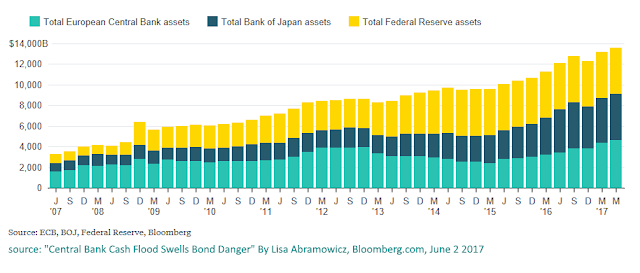
Central Bank Money Printing Central banks generally increase assets by printing money and buying them, so the charts below are indicative of their money printing. Historically, increase in central bank balance sheet (i.e. increase in money printing and supply of money) has led to inflation in goods and services (this is offset by deflation or wealth destruction and a bunch of other factors). Recently most of the money printing has been used to buy financial assets--for instance, the JCB is a big owner of Japanese stocks--so it is not clear to me if the situation will be similar to the inflationary busts we have seen in the past. Beyond inflation, too much central bank asset purchases also distorts the market and crowds out the private sector--not a good thing from a capitalist point of view (private sector makes better capital allocation decisions than the government). It's interesting how the main 3 developed country central banks have behaved over the last decade. ...

Sunday Spectacle CCXXVIII

Image
Decline in American C Corporations and the Rise of Pass-through Entities Catherine Mulbrandon from VisualizingEconomics.com always does good work on economics and business graphics and this is another great one on American corporations and tax collections. It clearly shows something that is not widely understood by the public at large. Namely, the number of American C corporations--these are the ones that pay corporate taxes*--have declined significantly in the last few decades. The number of pass-through entities--these are ones that don't pay corporate taxes but instead the owner is taxed directly*--has risen. The biggest impact from all this is the reduction in corporate double-taxation (which benefits owners of such companies) and the decline in taxes being collected from corporations (which hurts government/society**). * I'm being very simplistic here and there is more complexity to the notion of how corporate taxes are paid ** This is only true if you beli...